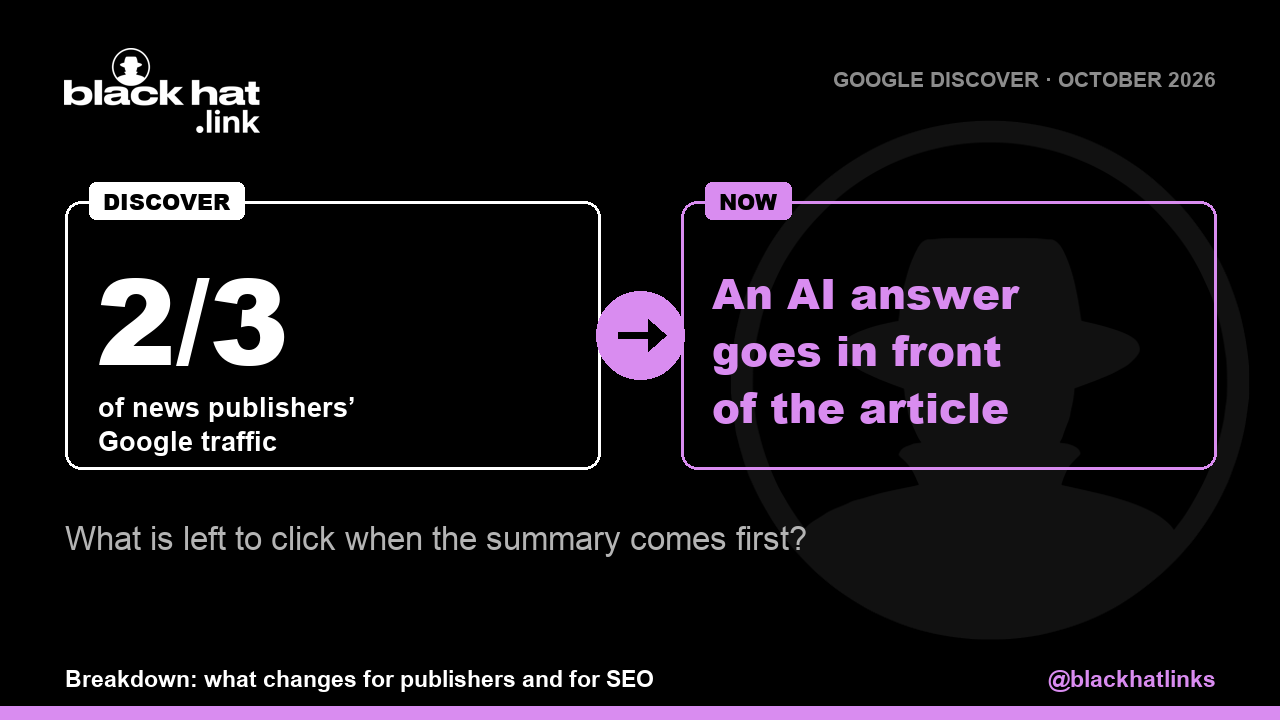
Discover sent news publishers two-thirds of their Google traffic. Now Google is putting an AI answer in front of the article
While everyone argues about AI Overviews in Search, the real bloodbath is starting where nobody was looking — in Google Discover. That feed in Chrome and on Android that, for the past two years, mattered more to media than the search results page itself.
The numbers nobody says out loud at conferences
Per data cited by Relevant Audience: Discover accounts for two-thirds of all Google referrals to the 2,000 largest news and media sites worldwide. Classic search's share of publisher traffic fell from 51% in 2023 to 27% in 2025. Discover didn't offset the losses — it masked them. As long as the feed kept growing, the GA charts looked tolerable, and nobody stopped to count that dependence on a single algorithmic channel — no keywords, no positions, no appeals — had reached two-thirds.
September 18: Dive deeper
Google's Robby Stein announced on X a test of a “Dive deeper” button on Discover cards. Google's wording: “a short topic overview with prominent links to related stories, community reactions and original reporting.”
In practice: tap the button and you get a Google-generated overview of the topic, with publisher links sitting below it as “source cards with truncated headlines and small thumbnails.” Not the article — a retelling of the article, after which the article is no longer needed.
The test is running on video cards. But researcher Damien Andell found configuration flags in the code covering two surfaces — video and articles — and two placements: an inline button and one that appears after a card is expanded. The article version is already built. It just hasn't been switched on.
Nicola Agius of UK publisher Reach called it “Google's latest attack on publisher traffic”: the summary already contains the key details, and the links beneath it are “hardly a setup for driving clicks.”
September 30: the dress rehearsal
While Dive deeper is in testing, the second wave of the spam update brought a string of identical posts on WebmasterWorld: “Discover and News traffic has again vanished,” “Discover vanished.” One owner: “Traffic dead.” Whether it was the spam update or a parallel Discover recalibration that took them out — Google, as usual, won't say. But this is what a site looks like when 60–70% of its traffic came from the feed and the feed stopped loving it: zero in a single day, no Search Console notice, no manual action, no reason.
Why this hits the grey market directly
Discover was Google's last truly black-to-grey channel. Search demands links, age, trust. Discover demanded a 1200px image, a clickbait headline and a fresh domain with a news-site template. Entire industries stood on that: networks of “regional news” sites with invented editorial teams, media sites built for arbitrage, expired domains with a news history that got into the feed inside two weeks. No backlinks, no content deeper than 300 words — just speed and CTR.
Google is closing it from both sides at once. The spam update with its two-week rollout cuts “scaled content” — and what is a typical Discover site if not scaled content? And Dive deeper takes the click even from those who survive: your headline is now a trigger for generating a summary, not for a visit.
What to do if you're sitting on Discover
- Measure your share right now. Search Console → Performance → Discover. If it's more than 40% of your Google traffic, you don't have traffic — you have a loan at a floating rate.
- Links are back in the equation. As long as Discover didn't require backlinks, nobody built them. Now the only thing that survives content updates is pages with external links. A Discover site with no link profile is a site with one traffic source and zero resilience.
- Discover drops are getting more expensive and less valuable at the same time. More expensive, because a domain's “news” history is the only fast way into the feed. Less valuable, because expired-domain abuse is a likely target of the current update, and a drop with someone else's history and your 500 AI news stories is the textbook example.
- Prepare for a Discover without the click. If Dive deeper rolls out to articles, the feed becomes one more AI Overview. The difference: in Search you at least have positions for queries; here you have only a card that Google either shows or doesn't.
Bottom line
Discover took two-thirds of publisher traffic away from Search and never once explained its rules. Now Google is putting AI summaries into it while simultaneously purging “scaled content.” For anyone who built grey media networks on the feed, this is the end of the “image + headline + drop” model. For everyone else, a reminder: a channel with no links, no positions and no appeals isn't a channel. It's a rental.
Bulk backlinks with articles, indexation from $0.025 per URL and a 48-hour turnaround.