Google officially switched off Parasite SEO penalties in Europe. Here's what that means for link building
Remember 2024, when Google declared war on “parasite SEO” — third-party content (casino, loans, coupons) dumped onto trusted domains to hijack their rankings? In Europe, that war is over. And Google didn't win it.
What happened
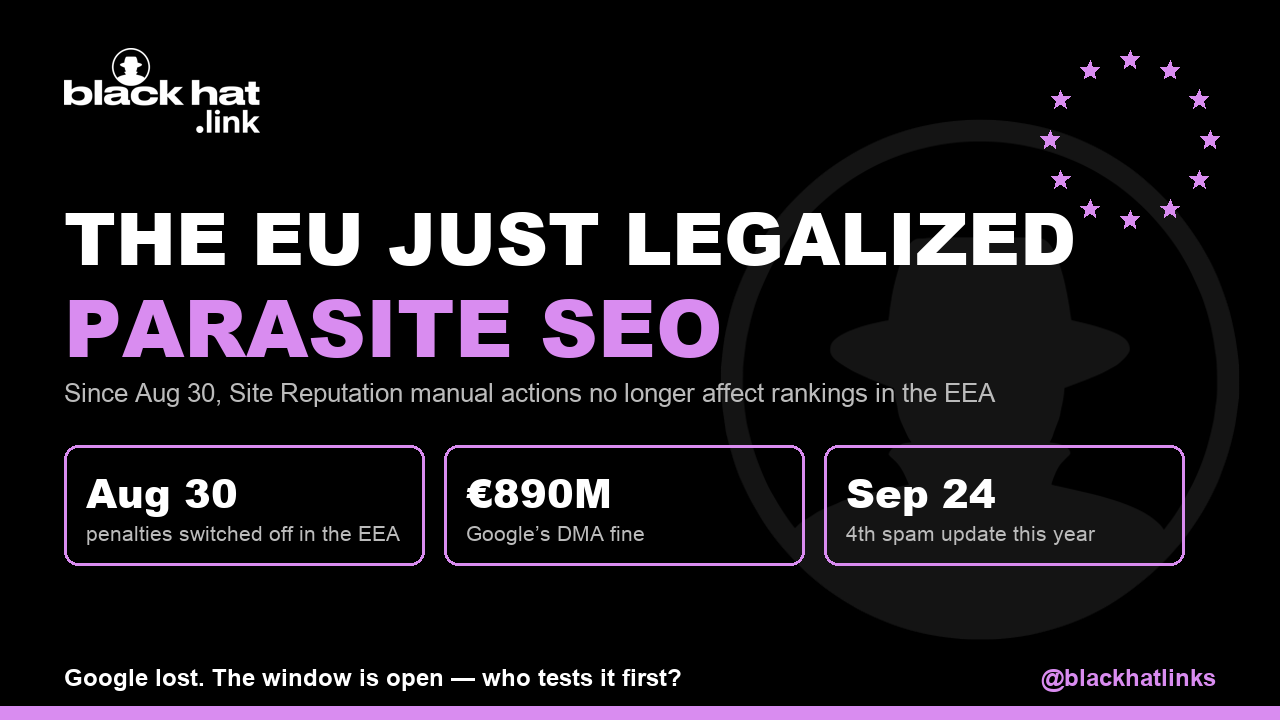
As of August 30, 2026, Google no longer applies manual actions under the Site Reputation Policy to searchers in the EEA — on orders from the European Commission. Context: the EU opened a DMA investigation in November 2025, then fined Google €890M for self-preferencing in Search and anti-steering (Search Engine Journal). The Commission's concern: the policy unfairly punished publishers and media hosting commercial-partner content.
The setup now: outside the EEA, a manual action still demotes the affected section of a site, the rest of the site is untouched. For a European site with international traffic, the same section can rank in the EU and get demoted in the UK or the US.
Google sulked publicly: European users suffer from parasite SEO and pay-to-play tactics just as much, but “we've agreed to change our enforcement approach for Europe.” Translation: they folded.
The nuances everyone's missing
- The manual action still shows up in Search Console — it just doesn't affect EEA rankings. You get the notice, nothing drops. A penalty with no penalty.
- Instead of manual actions, Google is building a system that separates “foreign” sections from the main site and ranks them on their own merits. The partner section stays indexed, but competes on its own signals instead of inheriting the host's reputation.
Read: parasite SEO doesn't get banned — it stops getting free PageRank. DR and other third-party metrics don't guarantee Google applies the same signals to every section of a domain. - Google also trimmed its list of violation examples and added four factors it uses to identify site reputation abuse. The policy got rewritten for the new reality.
And then the spam update landed
On September 24, Google rolled out the September 2026 Spam Update — global, all languages. That's the fourth spam update this year, the busiest year for spam updates in a long time. As of September 29 the rollout is still in progress, and it's the first spam update since the site reputation policy changed.
What matters for link builders: Google explicitly confirmed this update does not target link spam — it's aimed at scaled content abuse, parasite SEO and expired-domain abuse. One more caveat: site reputation abuse has historically been handled mostly by hand, through manual actions, not automated updates.
What to do with this
If you work in Europe, the paradigm shifted: manual-action risk is gone, but the free trust transfer is gone too. Parasite SEO in 2026 is a game of indexation speed and distribution, not PageRank. If a section only lives because of a strong domain — Google sees it and cuts it off.
For the rest of the world, old rules: a manual action can hit any page, but the effect is only visible to searchers outside the EEA.
The irony: the EU, trying to protect publishers, effectively legalized in Europe what Google calls spam. Who monetizes it first — the next few months will tell.
Bulk backlinks with articles, indexation from $0.025 per URL and a 48-hour turnaround.